

What Is Astigmatism and Can LASIK Fix It?
Key Takeaways
- Astigmatism occurs when the cornea is not perfectly round, causing light to focus unevenly on the retina and resulting in blurry or distorted vision.
- LASIK can correct astigmatism by reshaping the cornea, helping light focus properly on the retina and improving vision.
- LASIK and PRK are the most common surgical treatments for astigmatism, though they differ in how the cornea is accessed and how long recovery takes.
- Glasses and contact lenses can correct vision from astigmatism, but they do not permanently change the shape of the cornea.
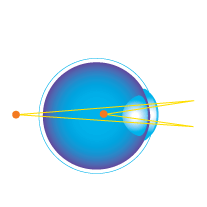
Astigmatism is a distortion in the cornea, the clear window of the eye. A perfect cornea is shaped like a sphere but with astigmatism, it’s shaped like a spoon. This causes light to focus on multiple points of the retina rather than a single point, leading to blurry vision.
LASIK corrects astigmatism by reshaping the cornea to be spherical, so light focuses clearly on the retina. Modern laser technology allows surgeons to customize astigmatism treatment to each patient’s needs. It can also correct nearsightedness and farsightedness.
How Do I Know If I Have Astigmatism?
- Keratometry measures the curvature of the cornea
- A refraction test (“Which is better, one or two?”) measures how much astigmatism you have and the direction it points (called axis)
- Corneal topography provides a detailed 3D map of the cornea surface.
Can You Get LASIK with Astigmatism?
Thanks to modern LASIK technology, you can absolutely get LASIK with astigmatism.
In LASIK surgery, a laser reshapes the cornea, allowing light to pass through the eye normally. It can correct a large amount of astigmatism, but if you have too much astigmatism, other options can help.
What Is the Best Eye Surgery for Astigmatism?
The most common surgeries, LASIK and PRK, both help to correct astigmatism. Depending on the person, LASIK eye surgery or PRK may be recommended.
LASIK vs. PRK — Which Eye Surgery Is Best for Astigmatism?
| LASIK | PRK | |
| Procedure | Uses a laser to create a thin flap on the cornea, which is then lifted. A second laser—called an excimer laser—reshapes the cornea. | Removes the upper layer of the cornea (epithelium). An excimer laser then reshapes the cornea, and the removed upper layer grows back naturally. |
| Recovery | Offers a quick recovery time, with most patients returning to normal activities within one to two days after surgery. | Has a slower recovery time of 3 to 6 days, with a more gradual healing process. Most patients return to normal activities within four days to a week. |
| Who is better suited? | Works better for most people because of the short recovery | May be better for patients with thinner corneas or dry eye issues. |
Can Astigmatism Be Corrected Without Surgery?
Glasses and contact lenses can correct astigmatism by changing how light enters the eye, but they don’t permanently alter the cornea’s shape.
LASIK or PRK might be a better option for certain people, including:
- Those who need thick eyeglass lenses to correct the problem
- Active people who want to be independent from glasses or contact lenses
- Those who suffer from eye irritation, dryness, or glare from contact lenses
LASIK Eye Surgery in Rochester, NY
You can explore personalized LASIK care and advanced vision correction and schedule a consultation with Flaum Eye Institute, a leader in laser vision correction. Flaum offers doctors who specialize in LASIK and PRK surgeries. Our team takes a detailed and personalized approach, ensuring each patient receives a customized plan as unique as their eyes.